Life on the Ranch

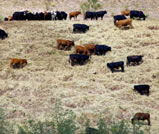
It has been a long, hard winter in Wyoming.  As a range conservationist, one of my duties is always to ensure that there is adequate forage for our livestock.  It becomes particularly critical in the cold winter months as the energy needs of cattle increase.  This is why it is so important to know what your range is capable of producing.  It is also important to understand which native plants will provide which nutrients even through the winter.  The symbiotic relationship between livestock (and wildlife) and the native plant communities they rely on must be taken in to consideration on a year around basis.  All of us can consider ourselves good range managers in the productive spring and summer months.  But one must be especially watchful of the nutrient requirements of the cattle in the winter, and must have a basic understanding of which perennial grasses and forbs will meet these requirements. 
 
At the Arapaho Ranch, our cattle range out on a year around basis.  Since we produce organic, grass-fed beef, our range management becomes vital to the success of finishing cattle through these long, hard winter months.  We have seen a decrease in live cattle weights recently, which equates to lower carcass weights and smaller yields.  We will have completed our first year of this program in February, so we really don't have a lot of data to look at. 
 
Besides diminished live cattle weights, another concern through the winter is road conditions. Since we ship one load of cattle each week to Colorado Springs for slaughter, we must keep a close eye on weather and road conditions.  We lost one week's production in November because of highway closures in southeastern Wyoming.  Last week it looked as if we might face the same problem, but, fortunately, Garritt Miller, the driver for Miller Ranch Transportation that hauls our cattle, braved the strong storm and was able to get the cattle delivered on time to the slaughter facility.  There is a local slaughter facility that is in the process of modifying its coolers and loading dock in order to qualify for federal inspection.  Once it obtains its federal inspection certification, we hope to work with this facility to acquire its organic certification.  When this is accomplished, we will be able to kill locally, which will give me fewer sleepless nights, and reduce our trucking expenses significantly.  It will also allow the product sold locally (at the Little Wind C-store in Ethete and at 789 Smokeshop and Casino south of Riverton) to be labeled organic.  This product currently, while it comes from certified organic, grass-fed cattle, cannot be labeled organic for the simple reason that it comes from animals killed in a non-certified plant.  This will change once this plant is certified organic. 
 
During our many conversations with customers in the Whole Foods' stores in the Rocky Mountain Region where our beef is sold, one thing that is stressed time and time again by our customers is that they want a local product, and that they want to have a personal connection with the producer.  They want to be able to look the producer in the eye when they ask where the product comes from and how the cattle are treated.  They do not trust conventionally raised and processed beef.  They also have very real concerns about protecting the environment, as well as the compassionate treatment of the animals that provide the product they choose to buy.  These consumers are becoming more and more educated in animal production practices, and they demand a product that is not only healthier for them, but a product that is raised under sustainable and environmentally conscientious standards.  This is one reason that we are seeing a dramatic rise in demand for grass-fed beef.  The organic certification only gives them an added assurance that the product comes from animals raised with great concern for the environment, along with ethical animal treatment standards. 
 
We must always keep the interests and demands of the customers above everything else.  Fortunately for us these demands and our production practices go hand in hand.  This is the most rewarding aspect of producing a beef product instead of just producing a commodity product.  We are able to connect intimately and directly with the end user.  They tell us what their concerns are.  And we make ourselves available for their questions about the ranch and how we care for the cattle.  We are always able to give them the answers they are looking for because we care as much as they do about protecting the environment and promoting healthy and balanced ecosystems - actually, probably more because not only does our livelihood depend on it, but the Northern Arapaho Tribe is deeply committed to the proper care and protection of its land.  The compassionate treatment of animals has always been practiced at the Arapaho Ranch, and now we have the bonus of knowing that our cattle will be treated compassionately and with dignity right through the processing stage.  This gives us a great sense of satisfaction.  Cattle producers most generally lose control over the handling of their animals once they are sold.  I would like to see more and more producers take a greater interest in what happens to their cattle once they leave the ranch.  I think this would have a positive effect on beef production.
 
Well, another week is in the books.  I hope to keep up with these posts on a regular basis.  My plans are to write a weekly posting.  It has taken some time to get this aspect of our website up and going.  But it is running now, so I don't have any excuses for putting off writing these posts.  So, I should be back next week.  Thanks for sharing these thoughts with me. 


Welcome to the ranch ...

organic_logo

The Arapaho Ranch is a wonderful example of a rejuvenated effort by the Northern Arapaho Tribe to reconnect with its strong traditions as a hunter/gather society whose very existence depended on its willingness to live in harmony with nature. The Ranch's USDA Organic Certification represents a strong commitment to biodiversity, and its grass-finished, organic cattle show the Tribe's belief in sustainable agriculture.

sawmill_cowAt present, the Ranch is able to support 3500 mother cows and over 2000 head of yearlings. Through careful management, as indicated by its diligent range and wildlife monitoring programs, the Ranch expects to be able to expand the cow herd to 4500 brood cows over the next three to four years, and finish close to 3500 yearlings each year on grass. By careful monitoring of range conditions, the Ranch can ensure that the cattle will always finish on a healthy diet of grass and forbs to provide the most flavorful, highest quality beef possible.

The Arapaho Ranch, established in 1940, is the pride of the Northern Arapaho Tribe. The rich soils and unique range conditions support strong communities of native grasses and forbs that allow cattle to graze year around. At 595,000 acres, the Arapaho Ranch is the largest certified organic operation in the country.

The main goal of management is to preserve the delicate balance in nature, while keeping alive traditional Native American values. The Ranch is vigilant in its protection of the diversity of species of plants and animals found here, ranging from the major predatory species of wolves, grizzly bears, coyotes, and mountain lions, through the large wild ungulate populations of moose, elk, and mule deer, down to the smallest mammals, birds and plant species. Through careful monitoring of wildlife and range conditions, along with proper grazing management, the Ranch is able to sustain healthy ecosystems where key symbiotic relationships are allowed to flourish. One such relationship is the unique relationship between predator and prey. Wolves, for instance, by their very presence, serve a unique purpose of discouraging wild ungulates and cattle from lingering too long in delicate riparian areas, thereby allowing these key ecosystems to flourish. This has the added bonus of preventing the spread of disease, which, in turn, reduces, or, in many cases, eliminates the need for antibiotics. The monitoring of these key symbiotic relationships is just one of the many tools the Arapaho Ranch uses to support its strong belief in the sustainability of organic ranching.

sawmill_basin

Address: 2080 Hamilton Dome Road Thermopolis, WY 82443
Phone: 307-867-2342 | Fax: 307-867-2567 | E-mail: hqranch@tctwest.net